Xander Ludwig · 29 September 2026
How Hierarchical Content Organization Influences Crawler Resource Allocation in Environments with Shifting Update Frequencies
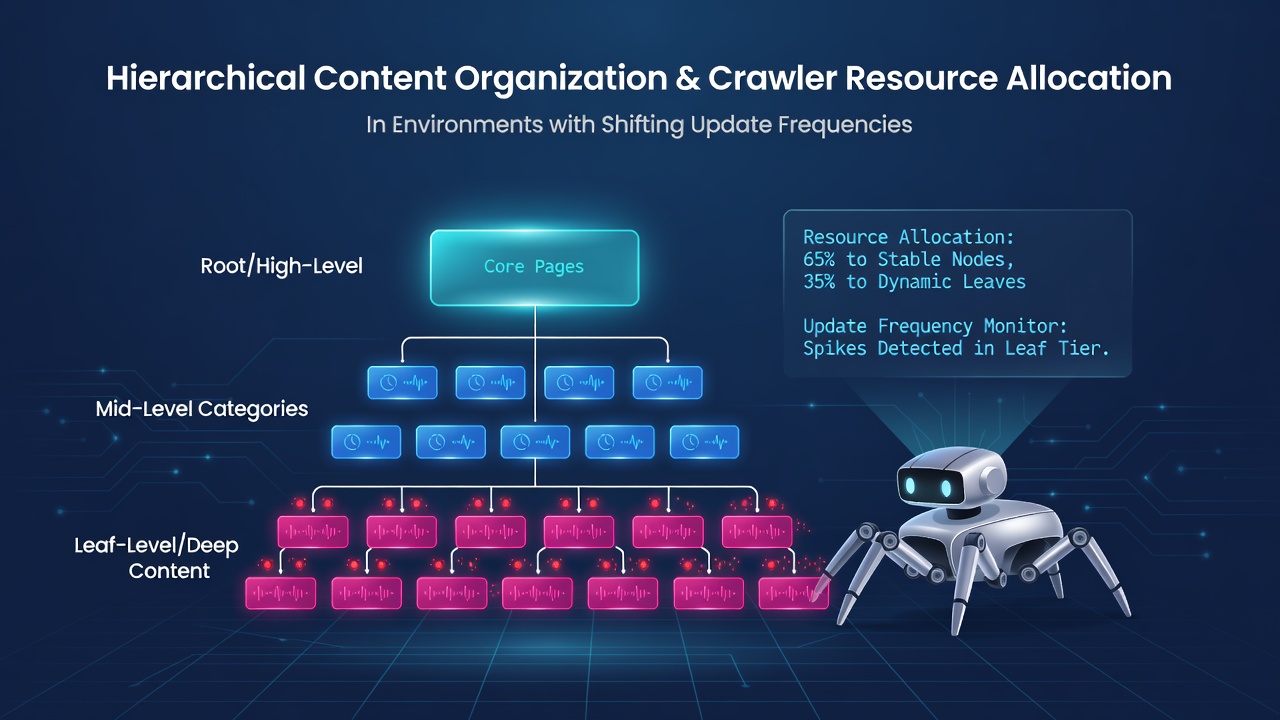
Web crawlers allocate limited processing power and bandwidth according to signals embedded in site architecture, and hierarchical content organization provides clear pathways that guide these decisions even when individual sections receive updates at different rates. Researchers have documented that deep category trees paired with shallow leaf nodes allow bots to prioritize high-value pages while deprioritizing stale branches, which becomes especially relevant as update frequencies shift across news feeds, product catalogs, and archival material.
Core Mechanisms of Hierarchical Structures
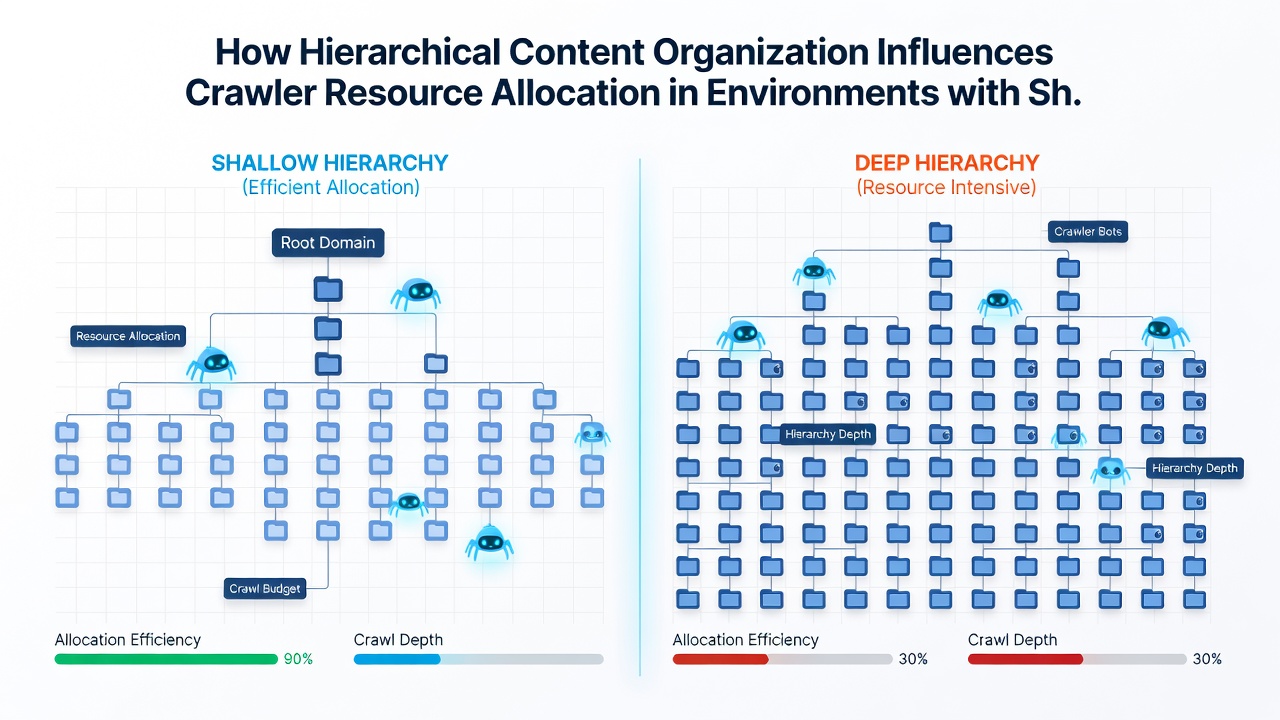
Content hierarchies typically arrange pages through parent-child relationships that search engine bots map during initial discovery passes, and this mapping influences subsequent visit schedules because crawlers treat strongly connected nodes as signals of importance. When a homepage links to category hubs that in turn link to detailed articles or product pages, the resulting graph lets algorithms assign crawl quotas more efficiently than flat directory layouts where every page competes equally for attention. Data from multiple large-scale web measurements shows that sites using three to four levels of nesting experience faster re-crawling of recently modified leaves compared with sites that bury updates behind dozens of clicks.
Allocation Patterns Under Variable Update Rates
Environments where some sections receive daily revisions while others remain static force crawlers to develop dynamic scheduling rules, and hierarchies help by clustering related change signals within the same branch. A news hub that updates every few hours can sit alongside an evergreen reference section that changes once per quarter, yet the parent category page still receives regular visits because bots follow the established tree rather than guessing which isolated URLs might have new content. Studies conducted by academic teams at institutions across North America and Europe indicate that this clustering reduces wasted requests on unchanged resources by up to thirty percent when hierarchies remain consistent over multiple crawl cycles.
By September 2026 several large publishing platforms had adjusted their internal linking patterns after observing that rapid frequency shifts in user-generated sections were causing disproportionate resource expenditure on low-priority archives, prompting wider adoption of explicit hub-and-spoke models.
Practical Effects Observed Across Different Site Types
E-commerce catalogs demonstrate the clearest outcomes because product pages often carry time-sensitive pricing data while category overviews stay relatively stable, and hierarchical navigation lets crawlers focus repeated visits on the volatile leaves without re-fetching entire category trees each time. Government portals that publish regulatory updates in dedicated subdirectories similarly benefit because the structure signals which branches warrant higher attention during periods of legislative activity. Observers note that when update frequency changes suddenly, such as during regulatory overhaul periods, sites with clear hierarchies recover optimal crawl distribution faster than those relying on flat XML sitemaps alone.
Interaction With Supporting Technical Signals
Internal linking, XML sitemaps, and last-modified headers interact with hierarchy to refine allocation further, yet the underlying tree remains the dominant organizing principle because bots traverse links in a depth-first or breadth-first manner depending on their configuration. When last-modified dates fluctuate rapidly inside one branch, crawlers learn to increase revisit rates for that subtree while maintaining baseline schedules elsewhere, and this learning accelerates when the hierarchy is both shallow enough for quick traversal and deep enough to isolate unrelated content. Research published through NIST technical reports and complementary work coordinated by Australian academic consortia has quantified these interactions across thousands of domains, confirming that structural clarity consistently outperforms reliance on date metadata alone.
Long-Term Stability Considerations
Over extended periods, hierarchies that remain stable even as individual update frequencies drift allow crawlers to build reliable predictive models, whereas frequent reorganization forces re-exploration and temporarily reduces allocation efficiency. Platforms that maintain consistent category trees while allowing leaf pages to appear or disappear report steadier crawl patterns, particularly when seasonal or event-driven spikes affect only specific subtrees. Those who have analyzed server logs across multiple years find that sites preserving hierarchy during frequency shifts experience fewer instances of important pages falling into low-priority queues.
Conclusion
Hierarchical content organization supplies crawlers with an enduring framework that supports efficient resource distribution regardless of how update frequencies evolve within different sections of a site. The patterns documented through institutional measurements and platform-scale observations demonstrate that well-structured trees reduce redundant requests and improve the speed at which new or revised content receives attention, outcomes that hold across commercial, governmental, and academic web environments alike.